
AI Data Collection for Healthcare: Common Challenges and Fixes
| Location | Dallas, Ellis, Johnson, Kaufman, Johnson |
| Date Posted | July 17, 2026 |
| Category |
Default
|
| Job Type |
Contract
|
Description
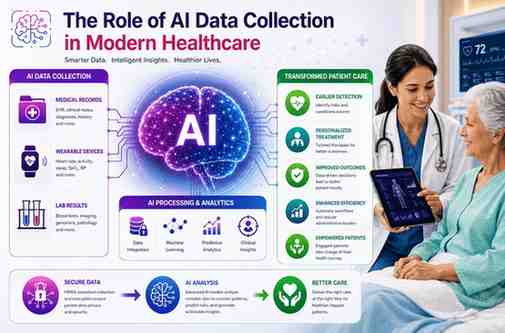
The healthcare industry is experiencing a digital transformation driven by Artificial Intelligence (AI). From predictive diagnostics to personalized treatment plans, AI is reshaping how providers deliver patient care. However, the effectiveness of any AI solution depends on one critical factor—high-quality data. Without accurate, diverse, and well-structured data, even the most advanced AI models can produce unreliable results.
AI Data Collection for Healthcare has become the foundation for developing intelligent healthcare applications that improve patient outcomes, reduce operational costs, and enhance clinical decision-making. Yet collecting healthcare data comes with significant challenges, including privacy regulations, data fragmentation, and inconsistent quality.
In this blog, we'll explore the most common challenges in AI data collection for healthcare and practical solutions organizations can implement to build reliable AI systems.
Why AI Data Collection for Healthcare Matters
Healthcare organizations generate enormous volumes of data every day through Electronic Health Records (EHRs), medical imaging, wearable devices, laboratory reports, insurance claims, and patient-generated health information.
AI models rely on this data to:
Improve disease diagnosis
Predict patient risks
Optimize hospital operations
Support clinical decision-making
Enable personalized medicine
Accelerate medical research
The better the data quality, the more accurate and trustworthy AI predictions become. That's why healthcare organizations must invest in structured, secure, and compliant AI data collection processes.
Challenge 1: Poor Data Quality
One of the biggest obstacles in AI Data Collection for Healthcare is poor-quality data. Medical records often contain incomplete information, duplicate entries, outdated records, and human errors.
Poor data quality results in:
Inaccurate AI predictions
Biased machine learning models
Increased operational costs
Reduced trust among healthcare professionals
Fix
Healthcare organizations should implement robust data validation procedures before AI model training. Automated quality checks, duplicate detection, standardized data formats, and continuous monitoring significantly improve dataset reliability.
Data annotation should also involve healthcare professionals to ensure clinical accuracy.
Challenge 2: Data Privacy and HIPAA Compliance
Healthcare data is among the most sensitive information collected today. Organizations handling patient records must comply with strict regulations such as HIPAA in the United States.
Improper handling of patient information may lead to:
Regulatory penalties
Legal consequences
Loss of patient trust
Security breaches
Fix
Secure AI data collection requires:
Data encryption during storage and transmission
Patient consent management
Data anonymization and de-identification
Role-based access controls
Regular security audits
Compliance should be integrated into every stage of the AI data lifecycle rather than treated as an afterthought.
Challenge 3: Fragmented Healthcare Data Sources
Healthcare information often exists across multiple disconnected systems, including:
Electronic Health Records
Imaging platforms
Laboratory systems
Pharmacy databases
Insurance platforms
Wearable health devices
This fragmentation creates incomplete patient profiles, making AI analysis less effective.
Fix
Organizations should adopt interoperable healthcare data standards such as FHIR (Fast Healthcare Interoperability Resources) and HL7 to enable seamless integration between systems.
Centralized data platforms and secure data lakes help consolidate information from multiple sources, providing AI models with a complete picture of patient health.
Challenge 4: Lack of Standardized Data
Medical terminology varies across hospitals, clinics, and healthcare providers. Different coding systems and inconsistent documentation make AI training difficult.
Examples include:
Different diagnosis codes
Inconsistent abbreviations
Variable imaging formats
Multiple laboratory naming conventions
Fix
Healthcare organizations should standardize datasets using recognized clinical coding systems such as ICD-10, SNOMED CT, and LOINC.
Standardization improves interoperability while increasing AI model accuracy across different healthcare environments.
Challenge 5: Insufficient Labeled Data
Machine learning models require labeled datasets to recognize diseases, identify abnormalities, and generate accurate predictions.
Unfortunately, medical annotation is expensive because it requires experienced clinicians.
Fix
Organizations can improve labeled data availability by:
Using AI-assisted annotation tools
Employing expert medical reviewers
Leveraging semi-supervised learning
Implementing active learning techniques
Combining public and proprietary datasets
These approaches reduce annotation costs while maintaining high-quality training data.
Challenge 6: Bias in Healthcare Data
Bias is one of the most critical concerns in AI Data Collection for Healthcare.
If datasets overrepresent specific age groups, ethnicities, or geographic regions, AI systems may generate inaccurate recommendations for underrepresented populations.
This can negatively affect healthcare equity.
Fix
Healthcare organizations should build diverse datasets representing various patient demographics, socioeconomic backgrounds, genders, and medical conditions.
Routine bias testing and fairness evaluations should be incorporated throughout AI development to identify and mitigate disparities before deployment.
Challenge 7: Managing Large Volumes of Healthcare Data
Hospitals generate terabytes of structured and unstructured data every year.
These include:
Medical images
Physician notes
Audio recordings
Pathology reports
Genomic data
IoT device information
Managing these massive datasets efficiently is a significant challenge.
Fix
Cloud-based AI infrastructure offers scalable storage and processing capabilities.
Healthcare organizations should also implement automated data pipelines that clean, organize, and prepare information for machine learning without excessive manual intervention.
Best Practices for Successful AI Data Collection for Healthcare
Organizations can maximize AI performance by following these proven best practices:
Establish clear data governance policies.
Prioritize HIPAA compliance from the beginning.
Standardize healthcare data formats.
Continuously monitor data quality.
Build diverse and representative datasets.
Use secure cloud infrastructure.
Collaborate with clinical experts during data annotation.
Regularly audit AI systems for fairness and accuracy.
These practices create a strong foundation for trustworthy healthcare AI applications.
The Future of AI Data Collection for Healthcare
As healthcare continues embracing digital innovation, AI data collection will become increasingly sophisticated. Emerging technologies such as federated learning, synthetic data generation, privacy-preserving AI, and real-time health monitoring will help organizations overcome traditional data challenges while maintaining patient privacy.
Healthcare providers that invest in scalable, compliant, and high-quality data collection today will be better positioned to leverage AI for predictive analytics, precision medicine, remote patient monitoring, and improved operational efficiency.
Conclusion
AI Data Collection for Healthcare is the backbone of every successful healthcare AI initiative. While challenges such as poor data quality, privacy concerns, fragmented systems, lack of standardization, and dataset bias remain significant, they are not insurmountable.
By adopting secure data governance practices, ensuring regulatory compliance, integrating interoperable systems, and investing in high-quality data annotation, healthcare organizations can unlock the full potential of AI. Reliable data leads to more accurate models, better clinical decisions, enhanced patient outcomes, and long-term innovation across the healthcare ecosystem.
For organizations seeking to build intelligent healthcare solutions, mastering AI data collection isn't just a technical requirement—it's a strategic advantage that drives better care, operational excellence, and sustainable growth.